


Flora and fauna on the Island of Elba
Plants:
Elba’ vegetation is mainly characterised by the Mediterranean ‘macchia’, a spontaneous formation of vegetation that can be found on the coasts of the north part of the Mediterranean. Its aspect is the one of a evergreen vegetation, often intricate because of the presence of lianes and climbing plants, and that can vary from low plants (macchia bassa) to higher ones (macchia alta), that can grow into a proper wood where ilex are the main tree. The ‘macchia’ in fact is a regressive form of the primitive Mediterranean forests of evergreen oaks (ilex and cork-oaks), nearly everywhere destroyed by man during the historical events that happened on the coasts of the Mediterranean sea.
On Elba, these events were also strongly linked to the mine industry, from the ages of the proto-history. Nevertheless, thanks to the development of agriculture instead of the sheep-farming, Elba can be considered one of the most green island of the Mediterranean.
Together with the evolved ‘macchia’ and to the copse of ilex, which are to be found mainly on the northern side of the island, there are spontaneous woods, such as chestnut, and woods of reforestation such as pine-woods. Pine trees have been vastly introduced on the island during the 1950s, especially on the deforested or abandoned hills by shepherds, with the aim of making the areas quickly green again.
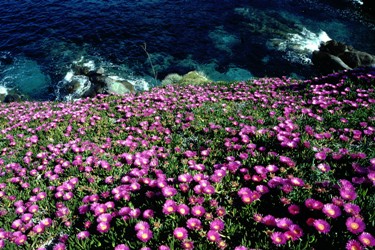
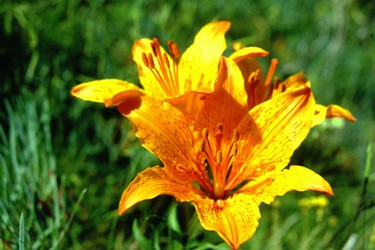
The ‘macchia’ is made of different species of spontaneous trees and plants high between 1 and 4 metres, with the exception of the ilex, of the cork-oaks and of the domestic pine trees, that where possible, rise above it. The most widespread trees, apart from the ilex and the cork-tree, can be found in the oldest part of the ‘macchia’: tree heath, strawberry tree, lentisco, laterno, viburnum and sporadically sorb; on the coasts there also is juniper, while in some valleys, such as in the one of San Martino, the laurel is also present.
In the low ‘macchia’, ilex and cork tree disappear and to the other species mentioned above can also be found shrubs such as myrtle, rillirea, cyst and broom. Where the activities that contribute to the decay of the macchia still happen (cutting, pasture and fires) there is an extremely low and rare vegetation (gariga) that can live with a poor and dry soil where the rock emerges from below.
The ‘gariga’, like the low ‘macchia’, during the spring presents nevertheless beautiful and odorous blooming, with cysts, brooms, mirto, rosemary, lavender, elicriso, and wild orchids. Areas with macchie-garighe can be found in the south coast of the island, due to the frequent fires that delay, if not stop, the development of the vegetation.
Along the south coast of the island, in the ‘macchia’, it can also be found exotic species of subtropical climate that are very interesting for their naturalization, such as prickly pear, native to South America, that in the autumn produces a delicious mature fruit; the agave, also native to the Central-South America, and palms.
Flowers:
The blossoming of the bushes on the island, that have leathery and hairy leaves and are often thorny and aromatic, is an explosion of dazzling colours: unfortunately though it is a show as much as suggestive as short-lived. In fact, after the blossoming in April, the following drought makes rapidly withers the flowers and the leaves of the trees.
Fauna:
Although man has negatively influenced the habitat and reduced the number of animal species, this island with its islet, is still a very interesting area for the variety of animals. An example of one of the characteristic species is the ‘Corsican’ sea-gull (Larus audouinii). The species of animals on the island can be divided into three main groups. The oldest group is the one native to Sardinia/Corsica which is characterised by a lot of endemic species of the hot climate. The second group, arrived on the island at the time of the Pleistocene, during the glaciations, includes animals of cold climates. The third group, finally, is to be considered as the ‘new’ group of animals imported in the Archipelago (Comunità Montana dell'Elba e Capraia). Of the first group we take as examples the cricket Rhacocleis tyrrhenica, the butterfly Hipparchia neomiris, the Tyrrhenian tree-frog (Hyla sarda), the Phyllodactylis europaeus, known as the ‘tarantolino’ (small tarantula) and, between the species of birds, the Corsican venturone (Serinus citrinella corsicanus), and the Sardinian magnanina (Sylvia sarda).
For the second group we mention a flat worm, the alpine Crenobia, that lives along the ditches, and the cricket Omocestus ventralis; for the third group we bring as examples another cricket, the Phyllodromica nagidi, another butterfly, the elbana Coenonympha, and a lizard, the Podarcis muralis colosii. On the Monte Capanne it is very easy nowadays to spot moufflons (Ovis musimom) and wild boars (Sus scrofa), species that were introduced by man in the 70s. Looking at smaller species of mammals, we can find wild cats (Felis silvestrìs), martens (Martes martes), hares (Lepus capensis), nowadays introduced for the hunting seasons, and dormice (Glis glis), and hedgehogs (Erinaceus europaeus).
Amongst the reptiles there are vipers (Vipera aspis francisciredi), grass snakes ‘with the collar’ (Natrix natrix helvetica), the ‘biacco’ (Coluber viridiflavus), the coluber ‘liscio’ (Coronella austriaca), the ‘tarantolino’ (Phillodactylus europaeus), the gecko ‘verrucoso’ (Hemidactylus turcicus), the tarantula ‘muraiola’ (Tarentola mauritanica), the green lizard (Lacerta virìdis), the lizard (Podarcis sicula campestris) and the ‘luscengola’ (Chalcides chalcides). Amongst the amphibians there is the commune toad (Bufò bufo), the tree-frog (Hyla sarda), the green frog (Rana esculenta), and the ‘smeraldino’ toad (Bufò viridis). Amongst the birds it is possible to spot a number of species as wide as the one that is present in inner land of Tuscany. Thanks to the existence of several different habitats in a small area, it is quite easy to see, even during the reproductive period, besides to sea-gulls, typical mountain species such as the ‘sordone’ (Prunella collaris), and in the marsh areas, the ‘cannaiola’ (Acrocephalus scirpaceus).
Amongst the birds of prey there is the ‘pellegrino’ hawk (Falco peregrinus brookei), the ‘gheppio’ (Falco tinnunculus), and the buzzard (Buteo buteo); amongst the nocturnal species there is the barn owl (yto alba), the owl (Athene noctua), and the horn owl (Otus scops). During the period of migration it is easy to see the ‘pecchiaiolo’ hawk (Pernis apivorus), the ‘cucolo’ hawk (Falco vespertinus), the ‘lodolaio’ (Falco subbuteo), the ‘albanella’ (Circus ssp.), and the ‘biancone’ (Circaetus gallicus).
Amongst the sea birds there are important and wide nidifications of imperial sea-gulls (Larus cachinnans michahellis), which are quickly increasing as a consequence of their easy adaptability to the environment (in contrary to the difficulties that the Corsican sea-gulls), and which are causing problems of competition with other bird species. Other important birds are the imperial crow (Corvus corax) and the red partridge (Alectoris rufa), although the presence of this last one is due thanks to breeding. The so called ‘minor’ fauna, it is also relevant, especially for what concerns the invertebrates and molluscs amongst which we can highlight the Solatopupa simonettae.
Flora:
Questa parte dell'isola e della costa è senz'altro la più spettacolare e caratteristica dell'Elba, oltre che la prediletta della maggior parte dei bagnanti. Tutte le stradine o sentieri hanno il loro sbocco in una insenatura più o meno grande.
Alle spalle di Fetovaia si incuneano verso la vetta del Monte Capanne strette valli, dalla morfologia aspra e poco accessibile. La vegetazione è bassa e rada, provata dalla esigua piovosità, dall'orientamento a sudovest e dall'esposizione al salmastro vento di libeccio.
Il paesaggio sembra appartenere a latitudini molto più meridionali di dove in realtà ci troviamo, ben diverso dal versante settentrionale della stessa montagna, caratterizzato da ombrosi e lussureggianti castagneti.
La spiegazione si trova nel fatto che la discreta altezza del Monte Capanne è in grado di fermare parte degli ammassi nuvolosi, provenienti da nord, le cui piogge si rovesciano sulle pendici esposate a settentrione.
La spiaggia di Fetovaia, la piû bella di questo versante dell'isola, è protetta da uno stretto promotorio che si allunga sul mare, verdeggiante di ginestre, lecci, e alti cespugli di macchia.
